Ray Bradbury
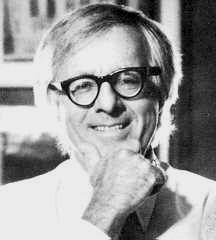
August 22, 1920
- Present |
"Pretty Good For Never Having
Gone To College, Ray
But When I Saw You On TV
I Felt You Owed Me An Apology
But Not For: Fahrenheit
451
Not For: Golden Apples of
the Sun
Not For: Something Wicked
This Way Comes
Not For: Martian
Chronicles, Volume One"
(Music and lyrics by BloodHag, ASCAP: Swords Against Music) |
Biography
American novelist, short-story writer, essayist, playwright, screenwriter, and poet. Ray Bradbury was born in Waukegan, Illinois on August 22, 1920, the third son of Leonard Spaulding Bradbury and Esther Marie Moberg Bradbury. In the fall of 1926 Ray Bradbury's family moved from Waukegan, Illinois to Tucson, Arizona, only to return to Waukegan again in May 1927. By 1931 he began writing his own stories on butcher paper. In 1932, after his father was laid off his job as a telephone lineman, the Bradbury family again moved to Tucson and again returned to Waukegan the following year. In 1934 the Bradbury family moved to Los Angeles, California.
Bradbury graduated from a Los Angeles High School in 1938. His formal education ended there, but he furthered it by himself -- at night in the library and by day at his typewriter. He sold newspapers on Los Angeles street corners from 1938 to 1942. Bradbury's first story publication was "Hollerbochen's Dilemma," printed in 1938 in Imagination!, an amateur fan magazine. In 1939, Bradbury published four issues of Futuria Fantasia, his own fan magazine, contributing much of the published material himself. Bradbury's first paid publication was "Pendulum" in 1941 to Super Science Stories. In 1942 Bradbury wrote "The Lake," the story in which he discovered his distinctive writing style. By 1943 he had given up his job selling newspapers and began writing full-time, contributing numerous short stories to periodicals. In 1945 his short story "The Big Black and White Game" was selected for Best American Short Stories. In 1947 Bradbury married Marguerite McClure, and that same year he gathered much of his best material and published them as Dark Carnival, his first short story collection.
His reputation as a leading writer of science fiction was established with the publication of The Martian Chronicles in 1950 (published in England under the title The Silver Locusts), which describes the first attempts of Earth people to conquer and colonize Mars, the constant thwarting of their efforts by the gentle, telepathic Martians, the eventual colonization, and finally the effect on the Martian settlers of a massive nuclear war on Earth. As much a work of social criticism as of science fiction, The Martian Chronicles reflects some of the prevailing anxieties of America in the early atomic age of the 1950's: the fear of nuclear war, the longing for a simpler life, reactions against racism and censorship, and fear of foreign political powers.
Another of Bradbury's best-known works, the novel Fahrenheit 451, was released in 1953 and is set in a future when the written word is forbidden. Resisting a totalitarian state which burns all the books, a group of rebels memorize entire works of literature and philosophy.
Ray Bradbury's work has been included in the Best American Short Story collections (1946, 1948, and 1952). He has been awarded the O. Henry Memorial Award, the Benjamin Franklin Award in 1954, the Aviation-Space Writer's Association Award for best space article in an American Magazine in 1967, the World Fantasy Award for lifetime achievement, and the Grand Master Award from the Science Fiction Writers of America. His animated film about the history of flight, Icarus Montgolfier Wright, was nominated for an academy award, and his teleplay of The Halloween Tree won an Emmy.
Ray Bradbury's writing has been honored in many ways, but perhaps the most unusual was when an Apollo astronaut named the Dandelion Crater on the Moon after Bradbury's novel, Dandelion Wine.
Outside of his literary achievements, Ray Bradbury was the idea consultant and wrote the basic scenario for the United States Pavilion at the 1964 New York World's Fair. He conceived the metaphors for Spaceship Earth, EPCOT, Disney World, and he contributed to the conception of the Orbitron space ride at Euro-Disney, France. He was creative consultant for the Jon Jerde Partnership, the architectural firm that blueprinted the Glendale Galleria, The Westside Pavilion in Los Angeles, and Horton Plaza in San Diego.
Ray Bradbury currently lives in California and is still actively writing and lecturing.
Bibliography
Dark Carnival (1947) -- Stories. (Published in England under the title The Small Assassin)
The Martian Chronicles (1950) -- Novel (Stories). (Published in England under the title The Silver Locusts)
The Illustrated Man (1951) -- Stories
No Man is an Island (1952) -- Speech.
Fahrenheit 451 (1953) -- Novel
The Golden Apples of the Sun (1953) -- Stories
The October Country (1955) -- Stories
Switch On the Night (1955) -- Children's Book
Dandelion Wine (1957) -- Novel
Sun and Shadow (1957) -- Story
A Medicine For Melancholy (1960) -- Stories. (Published in England under the title The Day It Rained Forever)
Something Wicked This Way Comes (1962) -- Novel
The Essence of Creative Writing: Letters to a Young Aspiring Author (1962) -- A selection of three letters, somewhat abridged, from Ray Bradbury to Clinton Lenoir. Published by the San Antonio, Texas Public Library.
R Is For Rocket (1962) -- Stories
The Anthem Sprinters And Other Antics (1963) -- Plays
The Machineries of Joy (1964) -- Stories
The Pedestrian (1964) -- Short Story. This limited edition of 280 copies were hand-printed by Roy A. Squires.
The Autumn People (1965) -- Published by Ballantine.
A Device Out of Time (1965) -- Play. Approximately 35 to 40 copies were prepared for Ray Bradbury's personal use in 1965. In 1976, the Dramatic Publishing Company published a trade edition.
The Vintage Bradbury (1965) -- Stories
The Day It Rained Forever: A Comedy in One Act (1966) -- A Play. Published by Samuel French, Inc., New York.
The Pedestrian: A Fantasy in One Act (1966) -- A Play. Published by Samuel French, Inc., New York.
S Is For Space (1966) -- Stories
Tomorrow Midnight (1966) -- Published by Ballantine.
Twice 22 (1966) -- Stories. Reprints the stories that appeared in A Medicine for Melancholy and The Golden Apples of the Sun.
Creative Man Among His Servant Machines (1967) -- Essay. A Xeroxed typescript consisting of twelve stapled leaves. A luncheon address to the Fifth Annual Meeting of Users of Automatic Information Display Equipment. Published by Stromberg Datagraphix, San Diego, California.
I Sing the Body Electric (1969) -- Stories
Old Ahab's Friend, and Friend to Noah, Speaks His Piece (1971) -- Poetry. 485 copies published by Roy A. Squires.
The Halloween Tree (1972) -- Novel
Pillar Of Fire: A Drama (1972) -- Play. This edition was issued prior to the collection Pillar Of Fire and Other Plays (1975). Only 35 to 40 copies were prepared for Bradbury's use.
The Wonderful Ice Cream Suit and Other Plays (1972) -- Plays
When Elephants Last In The Dooryard Bloomed (1973) -- Poetry
Zen in the Art of Writing and The Joy of Writing: Two Essays (1973) -- Essays. Published by Capra Press.
That Son of Richard III (1974) -- A limited edition pamphlet of 400 copies published by Roy A. Squires.
Pillar of Fire and Other Plays (1975) -- Plays
Long After Midnight (1976) -- Stories
That Ghost, that Bride of Time: Excerpts from a Play-in-Progress (1976) -- Play. Based on the Moby Dick mythology and dedicated to Herman Melville. This was a numbered limited edition of 400 copies, the first 150 of which were signed by Ray Bradbury.
Where Robot Mice and Robot Men Run 'Round in Robot Towns (1977) -- Poetry. Published by Alfred A. Knopf.
The God in Science Fiction (1978). Quarto. Published by Santa Susanna Press.
The Mummies of Guanajuato (1978) -- Story. Photography by Archie Lieberman.
Twin Hieroglyphs that Swim the River Dust (1978) -- Poetry. A signed and numbered limited edition of 300 copies from Lord John Press.
Beyond 1984: Remembrance of Things Future (1979). A signed limited edition of 350 copies from Targ Editions.
This Attic Where the Meadow Greens (1979) -- A signed and numbered limited edition of 300 copies from Lord John Press.
The Ghosts of Forever (1980) -- Includes a prologue by the author and an illustration by Aldo Sessa. Published by Rizzoli Press.
The Last Circus and the Electrocution (1980) -- Stories. A limited cloth edition from Lord John Press.
Stories of Ray Bradbury (1980) -- Stories
The Complete Poems of Ray Bradbury (1981) -- Poetry
The Haunted Computer and the Android Pope (1981) -- Poetry
Then Is All Love? It Is, It Is! (1981) -- Poem. A signed limited edition of 230 copies published by the Orange County Book Society.
There Is Life On Mars (1981) -- published by Reader's Digest Press.
The Love Affair (1982) -- Story and Poems
The Other Foot (1982) -- Story. Published by Perfection Form Co.
The Veldt (1982) -- Story. Published by Perfection Form Co.
Dinosaur Tales (1983) -- Stories. Originally published by Byron Preiss Visual Publications. Re-printed in 1996 by Barnes and Noble Books.
Forever and the Earth (1984) -- Radio Dramatization. This was a limited edition of 300 copies published by Croissant Press, signed and numbered by the author.
The Last Good Kiss (1984)
A Memory of Murder (1984) -- Stories
Death Is a Lonely Business (1985) -- Novel
The April Witch: A Creative Classic (1987) -- Story. Illustrated by Gary Kelly. Published by Creative Education, Inc.
Death Has Lost Its Charm For Me (1987) -- Poetry. Published by Lord John Press.
Fahrenheit 451 / The Illustrated Man / Dandelion Wine / The Golden Apples of the Sun / The Martian Chronicles (1987) -- Novels and Stories
Fever Dream (1987) -- Story. Illustrated by Darrel Anderson.
The Fog Horn: A Creative Classic (1987) -- Story. Illustrated by Gary Kelley. Published by Creative Education, Inc.
The Other Foot: A Creative Classic (1987) -- Story. Illustrated by Gary Kelley. Published by Creative Education, Inc.
The Veldt: A Creative Classic (1987) -- Story. Illustrated by Gary Kelley. Published by Creative Education, Inc.
The Dragon (1988) -- Story
Falling Upward (1988) -- Play. Published by the Dramatic Publishing Company.
The Toynbee Convector (1988) -- Stories
The Climate of Palettes (1989) -- A signed and numbered limited edition of 150 copies from Lord John Press.
The Day It Rained Forever (1990) -- Musical
A Graveyard For Lunatics (1990) -- Novel
Zen in the Art of Writing (1990) -- Essays on the art and craft of writing.
Classic Stories Volume One (1990) -- Stories. This volume contains the two previous collections The Golden Apples of the Sun and R Is For Rocket.
Classic Stories Volume Two (1990) -- Stories. This volume contains selections from the two previous collections A Medicine For Melancholy and S Is For Space.
Selected from Dark They Were, and Golden-Eyed (1991) -- Story
Ray Bradbury On Stage: A Chrestomathy of Plays (1991) -- A collection of previously published stage plays. Published by Donald Fine, Inc.
Yestermorrow: Obvious Answers to Impossible Futures (1991) -- Essays.
Green Shadows, White Whale (1992) -- Novel
The Stars (1993) -- Poem.
Quicker Than The Eye (1996) -- Stories
Driving Blind (1997) -- Stories
Dogs Think That Every Day Is Christmas (1997) -- Poem
With Cat for Comforter (1997) -- Poem