A.E. Van Vogt
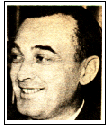
Born 1912
Died Feb. 2000
|
A cult hero in the 50s you
couldn't put Van vogt down
He wrote Slan about a futuristic superman
With two brains and ESP
The World of Null-A and it's two successive
sequels were full of general semantic theory
Maybe if everybody spoke Esperanto he wouldn't
of started back up in the 60s
Sequels to Slan all paled next to the original
He spent twenty years pushing Dianetics He
seemed old-fashioned and stale...
A.E. Van Vogt! A.E. Van Vogt! (repeat)
|
Biography
Alfred Etan van Vogt was born in Canada in 1912. Almost without any formal education, he began a writing career in his late twenties, moving to the United States after the second World War. A.E. van Vogt is arguably the greatest of all pulp SF writers. His first published SF story ("Black Destroyer"), is considered by many to have launched the so-called Golden Age of american magazine science fiction. For ten years, his was the defining voice of magazine science fiction:
"...his nearly invincible alien monsters, the long timespans of his tales, the time paradoxes that fill them, the quasimessianic supermen who come into their own as the stories progress, the galactic empires they tend to rule and the states of lonely transcendental ominipotence they tend to achieve-all are presented in a prose that uses crude dark colours but whose striking sense of wonder is conveyed with a dream-like conviction...."
John Clute
The best of van Vogt dates from these extraordinary years. They were followed by almost twenty years of absence, which he largely consecrated to "working on his brain" with Hubbard's dianetics in Hollywood. When he finally returned to writing novels during the seventies, he never attained the same intensity which marked his early years as a writer. His attempt to adapt his prose to a more colloquial and contemporary style led to a loss of evocatory power. Concurrently, his ideational content, much of it consecrated to advanced mental states, had moved to the fore: the unconscious rapture of the early van Vogt had been replaced by the rather labored expositions of the late van Vogt. Indeed these late novels have probably blurred his early achievement. For it is the early van Vogt who interests us. He transcends gloriously his pulp material.
Though Van Vogt remains one of the most popular SF writers worldwide, he has suffered an eclipe in the U.S. Certainly the drive towards middle class acceptance which has animated the SF establishment for the last generation (with considerable success!), has no room for the inspired madness of a van Vogt. Indeed, he has been a great embarassment to a genre which has otherwise embraced with equanimity the stolid liberal platitudes of an Asimov or a Sturgeon, and the right-wing panaceas of Heinlein and his coevals. Save for the notable exceptions of Philip K. Dick or Barry Malzberg, van Vogt has almost no american defenders of consequence. It is in the U.K., France, Brazil and Sweden that he has found his most ardent advocates. For van Vogt does not write "speculative fiction", social novels of the future, or scientific extrapolation. He possesses none of the literary, political or scientific graces which might endear his writing to the powers that be. Largely innocent of science (for the "sciences" he deals with are general semantics, "totipotency", Batesystem vision restoration, "similarization", dianetics, spenglerian cyclical history, "nexialism" and other slightly deranged systems of his own confection), van Vogt has been the ablest and greatest practitioner of what John Clute has called the "hard SF dream". The hallucinatory vividness of these hard SF dreams, the frenetic exercice of what a french critic has termed his "rationalized dementia" ensure that he will never be embraced by Middle America. It is impossible to discern any "relevance" to his fiction, and often difficult to even say "what it is about". There is no pandering to "realism" with van Vogt. As he says himself, van Vogt practises "unreality writing". The elemental forces which he describes and unleashes which such disregard for plausibility or verisimilitude (and sometimes grammar!), cannot be pigeon-holed within the ritual dance of genre SF. Furthermore, they are parallelled by the flamboyant and spectacular nature of his writing (really quite sophisticated when compared to that of the rest of Campbell's "Astounding" stable). Most science fiction is laborious and dull reading, even that of the "great" names. Not van Vogt. His writing may often be atrocious, violent and crude but the "high neanderthal" pulp style of his great years was never dull, and he occasionally attained blessed moments of surreal grandeur. That sheer demonic power which his writing sometimes attains, is enough to set him apart from the the rather pedestrian pages of the rest of the "Astounding" crew.
All of this ensures that he cannot be identified with any recognizable group or school, or easily imitated as a writer. (Though Dick, Harness and even Blish more than once attempted to do so, the first two with some success.) Van Vogt is an original who will never achieve the middle-class respectability to which contemporary SF aspires, as he systematically subverts and frustrates not only the genre conventions but even the very aspirations of his readers. Thus van Vogt has been a controversial figure in american science fiction almost from the start. Described as a "cosmic jerry-builder" by a young Damon Knight, considered with olympian disdain by the acerbic William Atheling Jr. (Blish), he has been cruelly neglected by the merchants who run the contemporary SF scene, who prefer to play it safe with more presentable figures: the platitudinous Asimovs, the boorish Heinleins. But when all the pulps are finally turned to dust and the hype is forgotten and long gone, some true perspective will restore van Vogt to his rightful place as the cosmic overlord of genre science fiction.
"This much we have learned. Here is the race that shall rule the sevagram." -A.E. van Vogt
"...others write about the future...van Vogt writes from the future..." -unknown, mid-twentieth century
bibliography
Novels and collections in chronological
order:
1946:
Slan
The Weapon Makers
1947:
The Book of Ptath
1948:
Out of The Unknown
The World of Null-A
1950:
The House That Stood Still
Masters of Time
The Voyage of the Space Beagle
1951:
The Weapon Shops Of Isher
1952:
Away and Beyond
Destination: Universe
The Mixed Men
1953:
The Universe Maker
1954:
Planets for Sale
1956:
The Pawns of Null-A
1957:
Empire of the Atom
The Mind Cage
1959:
Triad
The War against The Rull
Siege of the Unseen
1962:
The Violent Man
The Vizard of Linn
1963:
The Beast
1964:
The Twisted Men
1965:
Monsters
Rogue Ship
1966:
The Winged Man
1967:
The Changeling
The Van Vogt Omnibus
1968:
The Far-out Worlds of A. E. van Vogt
1969:
The Silkie
1970:
Quest for the Future
Children of Tomorrow
1971:
The Proxy Intelligence and Other Mind Benders
M33 in Andromeda
More Than Superhuman
The Battle of Forever
The Van Vogt Omnibus 2
1972:
The Darkness on Diamondia
The Book of Van Vogt
1973:
The Three Eyes of Evil
Future Glitter (Tyranopolis)
1974:
The Secret Galactics
The Best of A. E. van Vogt
The Man with a Thousand Names
1977:
Supermind
The Anarchistic Colossus
1978:
Pendulum
1979:
The Best of A. E. van Vogt 1940-1948
The Best of A. E. van Vogt 1949-1968
Renaissance
The Enchanted Village
1980:
Cosmic Encounter
1983:
Computerworld
1984:
Null-A 3
1985:
To Conquer Kiber
1987:
The People of The White Sands